

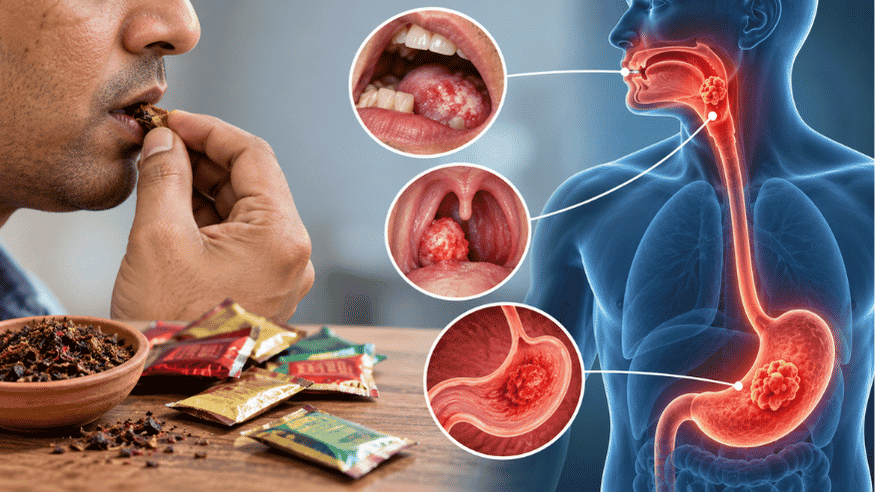
A pouch of gutkha costs five rupees. It takes about ten minutes to finish. Most people who chew it have been doing so for years without a single day of pain, and that is exactly why the habit is so difficult to take seriously.
But mouth cancer is one of the most common cancers in Indian men, and Rajasthan sits in the high-burden belt for smokeless tobacco use. Unlike many cancers that arrive without explanation, this one has a cause we can name, see and stop. That is the important part of this article: almost every mouth cancer caused by tobacco passes through a warning stage first — a stage that is visible, painless and completely treatable if someone looks.
This article explains what tobacco actually does inside the mouth, throat and stomach, how long the damage takes, what the early signs look like, and when you should get checked.
What counts as tobacco
Many people who would never smoke a cigarette use tobacco every day without thinking of it as tobacco at all.
Smokeless tobacco in India includes gutkha, khaini, zarda, mawa, pan masala with tobacco, snuff, mishri and the tobacco added to a betel quid (paan). Areca nut — supari — is a separate substance, but the International Agency for Research on Cancer classifies it as a carcinogen in its own right. Pan masala advertised as “tobacco-free” still usually contains areca nut, which is why it is not the safe alternative it is marketed as.
Smoked tobacco includes cigarettes, bidis and hookah. Bidis are often assumed to be milder because they are smaller and unfiltered — in practice they require deeper, more frequent puffs, and the smoke is not gentler on the throat or lungs.
If you use any of the above, this article applies to you.
What tobacco does inside the mouth
Chewing tobacco is not swallowed quickly. It is parked — tucked into the cheek or under the lip and held there, often for twenty or thirty minutes, several times a day. That is what makes it so damaging.
Three things happen in that spot.
Chemical injury. Tobacco contains tobacco-specific nitrosamines, formed during curing and fermentation. These are among the most potent carcinogens known. Held against the cheek lining, they are absorbed directly into the tissue, hour after hour, day after day.
Physical injury. Areca nut is coarse and fibrous. It abrades the lining of the mouth continuously, creating tiny wounds that heal and re-open. Damaged tissue absorbs chemicals faster than intact tissue.
Loss of protection. Saliva normally washes the mouth clean. A tobacco quid held in place blocks that flushing action in exactly the spot where the carcinogen sits.
The result is a small area of the mouth exposed to a strong carcinogen, repeatedly, with the body’s natural defence switched off. Cells there begin to accumulate genetic damage. Most damaged cells die or are repaired. Over years, some are not — and those are the ones that become cancer.
The warning stage most people miss
Mouth cancer rarely appears overnight in healthy tissue. It usually develops out of a precancerous condition — an abnormal patch that is not yet cancer but has a meaningful chance of becoming one. These conditions are visible to the naked eye and painless, which is precisely why they get ignored.
Leukoplakia is a white patch that cannot be scraped off. It is the most common precancerous change and often sits exactly where the quid is held.
Erythroplakia is a red, velvety patch. It is far less common than leukoplakia but carries a much higher risk of turning cancerous, so a red patch should never be watched and waited on.
Oral submucous fibrosis (OSMF) is strongly linked to areca nut and is common in India. The lining of the mouth gradually stiffens and loses elasticity. The first symptom most people notice is a burning sensation with spicy food. Later, the mouth opens less than it used to. Many patients only realise something is wrong when they can no longer fit two or three fingers between their teeth. OSMF is not reversible once fibrosis is established, and it carries a long-term risk of malignant change.
Tobacco pouch keratosis is the thickened, wrinkled grey-white area at the exact spot where the quid is habitually placed.
If you use tobacco and any of these are present, that is not a reason to panic — it is a reason to get examined now, while the problem is still at a stage that can be managed. Our post on warning signs of mouth cancer you shouldn’t ignore covers what to look for in more detail.
How tobacco affects the throat
The carcinogens do not stay in the mouth. Tobacco juice mixes with saliva and is swallowed repeatedly, carrying nitrosamines down the throat and food pipe.
This exposes the pharynx, larynx (voice box) and oesophagus to the same chemicals. Throat cancers announce themselves differently from mouth cancers: a hoarse voice that does not settle after two or three weeks, persistent difficulty or pain on swallowing, a lump in the neck, a feeling of something stuck in the throat, or an unexplained persistent cough.
A hoarse voice lasting more than three weeks in a tobacco user should always be examined — usually with a simple scope in the ENT department. It very often turns out to be something harmless. When it is not, catching it at this stage changes everything.
Alcohol matters here too. Alcohol on its own raises the risk of these cancers, but combined with tobacco the effect is multiplicative, not additive — alcohol acts as a solvent, helping tobacco carcinogens penetrate the tissue lining more deeply.
How tobacco affects the stomach
The link between tobacco and stomach cancer is less widely known but well established. Swallowed carcinogens reach the stomach lining directly. Tobacco also promotes chronic gastritis, worsens acid reflux, and interferes with the healing of the stomach lining.
There is an important interaction with Helicobacter pylori, the bacterium behind most stomach ulcers and a major stomach cancer risk factor in India. In people who carry H. pylori, tobacco use raises stomach cancer risk considerably more than either factor alone.
Stomach cancer is difficult to catch early because its symptoms — indigestion, bloating, feeling full quickly, mild upper abdominal discomfort — are the same as ordinary acidity. Most people self-medicate with antacids for months. A tobacco user over 40 with new, persistent indigestion, unexplained weight loss, black stools or vomiting should not treat it as acidity; they should be evaluated, usually with an endoscopy through the gastroenterology department.
Smoking also raises the risk of lung, bladder, pancreatic, kidney and cervical cancers. Our article on lung cancer symptoms in smokers and non-smokers explains why lung cancer can be missed even in heavy smokers.
How long does it take?
There is no fixed number, and anyone who gives you one is guessing. What is reasonably well established is the pattern.
Precancerous changes commonly appear after roughly five to ten years of regular use, though this varies widely. Progression from a precancerous patch to cancer, when it happens, typically takes several more years. Risk rises with the amount used per day, the number of years of use, and how long each quid is held in the mouth.
Two things follow from this. First, the long timeline is why so many users feel safe — nothing hurts for a decade. Second, that same long timeline is a genuine opportunity. There are years of visible warning before cancer develops, and screening during those years is what saves lives.
What quitting actually does
The risk does not vanish the day you stop, but it does start falling, and it keeps falling.
Oral cancer risk in former smokeless tobacco users drops substantially over the years after quitting, moving progressively closer to that of a never-user. Early leukoplakia patches often shrink or disappear entirely once the irritant is removed. The burning sensation of early OSMF frequently improves. And for anyone already diagnosed with cancer, quitting improves how well treatment works and lowers the chance of a second cancer developing.
Practical points that help: pick a quit date rather than deciding to cut down gradually, because tapering rarely works with tobacco. Identify your trigger moments — after meals, during travel, at work breaks — and plan a substitute for each, such as saunf, elaichi or sugar-free chewing gum. Tell your family you have quit so the habit loses its privacy. Nicotine replacement therapy and prescription medication genuinely help and are worth discussing with a doctor. The national quitline (1800-11-2356) is free.
Relapse is normal. Most people who successfully quit tobacco needed more than one attempt. A relapse is a data point, not a failure.
When to get screened
An oral cancer screening is quick, painless and does not involve any equipment beyond good light and a trained eye. A specialist examines the mouth, tongue, under-tongue area, cheek lining and gums, checks how wide the mouth opens, and feels the neck for lymph nodes. It takes a few minutes.
Get checked without waiting for symptoms if you use any form of tobacco or areca nut, if you have used tobacco in the past for several years, or if you already have a white or red patch, or a mouth that opens less than it used to.
Get checked urgently — do not wait — if you have a mouth ulcer that has not healed in three weeks, a lump in the mouth or neck, a hoarse voice lasting over three weeks, unexplained bleeding in the mouth, numbness of the lip or tongue, loose teeth without dental cause, or difficulty swallowing.
A three-week non-healing ulcer is the single most important rule to remember. Ordinary mouth ulcers heal in seven to ten days.
Our guides on early warning signs of cancer and why early detection is your best defence explain the wider picture of early diagnosis.
What happens if something is found
Finding a suspicious patch does not mean cancer. The next step is usually a biopsy — a small tissue sample examined under a microscope to determine exactly what the cells are doing. This is the only way to distinguish a harmless patch from a precancerous or cancerous one.
If it is precancerous, treatment usually means removing or monitoring the patch, plus complete tobacco cessation. If cancer is confirmed, imaging determines the stage, which drives everything about treatment planning. Early-stage oral cancers are often treated with surgery alone and have good outcomes. Later stages may need a combination of surgery, radiation therapy and chemotherapy, planned together by a multidisciplinary team. Nutrition support matters throughout, particularly for head and neck cancers where eating becomes difficult — our guide to the best diet for cancer patients during treatment covers this.
Cancer care in Ajmer
At the Kshetrapal Comprehensive Cancer Centre, oral, throat and stomach cancers are managed by a team working together across surgical oncology, medical oncology and radiation oncology, with diagnostic support from pathology and radiology. Screening examinations and tobacco cessation guidance are available for patients from Ajmer, Kishangarh, Beawar, Nasirabad, Pushkar and nearby areas.
If you use tobacco in any form, book an oral screening. It takes five minutes, and it is the only step in this entire article that has to happen before symptoms start.
This article is for general information and awareness. It is not a substitute for examination and advice from a qualified doctor. If you have any symptom described above, please consult a specialist.