

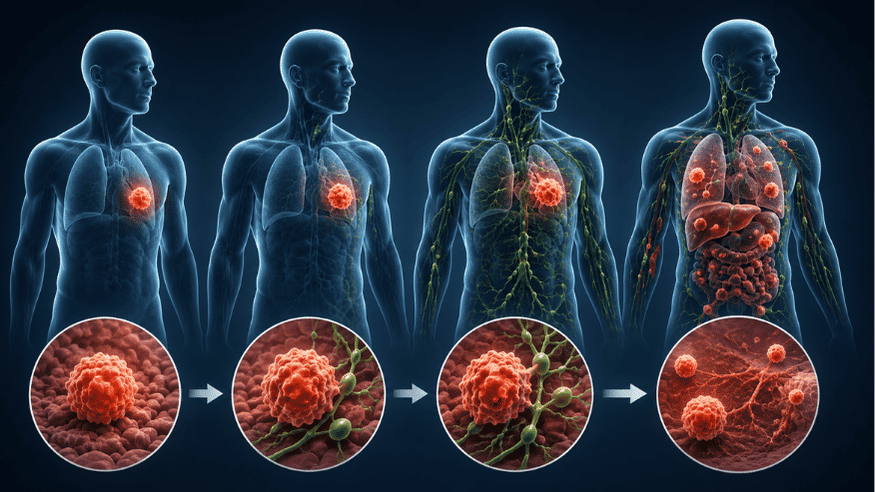
Cancer staging describes how far cancer has spread in the body, ranging from Stage 1, where cancer is small and localized, to Stage 4, where it has spread to distant organs. Doctors use staging to plan the right treatment approach and to give patients a clearer picture of what to expect. Understanding your stage helps you ask the right questions and make informed decisions about care.
Hearing a cancer diagnosis is overwhelming enough, and the added confusion of stage numbers can make it harder to process. This article breaks down what each stage generally means, how doctors determine it, and why the stage number is only one part of the full picture.
What Does Cancer Staging Actually Mean?
Cancer staging is a system doctors use to describe the size of a tumor and how far it has spread from where it started. Staging helps answer three important questions: how large is the tumor, has it spread to nearby lymph nodes, and has it spread to other parts of the body. This information directly shapes the treatment plan and helps predict how the cancer is likely to behave.
Most cancers are staged using a system called TNM, where T stands for tumor size, N stands for lymph node involvement, and M stands for whether the cancer has metastasized, or spread, to distant organs. These three factors are then combined into an overall stage number from 1 to 4.
Stage 1: Early and Localized
Stage 1 cancer means the tumor is small and has not spread beyond the organ where it started. There is typically no involvement of nearby lymph nodes or distant organs at this stage.
Key points about Stage 1 cancer:
- The tumor is usually small in size
- Cancer cells have not spread to lymph nodes
- There is no spread to other organs or tissues
- Treatment is often more straightforward and may involve surgery alone or surgery combined with other therapies
- Outcomes at this stage are generally the most favorable, since the cancer is caught early
This is why early detection through regular screening matters so much, since catching cancer at Stage 1 significantly improves the chances of successful treatment.
Stage 2: Growing but Still Contained
Stage 2 cancer typically means the tumor has grown larger than in Stage 1, and there may be limited spread to nearby lymph nodes, though it has not yet reached distant organs.
Key points about Stage 2 cancer:
- The tumor is larger compared to Stage 1
- There may be minimal involvement of nearby lymph nodes, depending on the cancer type
- The cancer remains within or close to the organ where it started
- Treatment often combines surgery with additional therapies like chemotherapy or radiation
- This stage still generally offers a good outlook, especially with prompt treatment
Stage 3: Locally Advanced
Stage 3 cancer indicates that the tumor has grown further and has spread more significantly to nearby lymph nodes or surrounding tissues, but it has not yet spread to distant parts of the body.
Key points about Stage 3 cancer:
- The tumor is larger and more advanced than in Stage 2
- There is more significant involvement of nearby lymph nodes
- Cancer may have spread to nearby tissues or structures
- Treatment usually involves a combination of surgery, chemotherapy, and radiation therapy
- Treatment planning becomes more complex, often requiring a team of specialists working together
Stage 4: Advanced or Metastatic
Stage 4 is the most advanced stage, meaning the cancer has spread from its original location to distant organs or tissues, such as the liver, lungs, bones, or brain. This is often referred to as metastatic cancer.
Key points about Stage 4 cancer:
- Cancer has spread beyond the original site to distant organs
- Treatment focuses on controlling the disease, managing symptoms, and improving quality of life
- Options may include chemotherapy, targeted therapy, immunotherapy, radiation, or a combination of these approaches
- Some patients with Stage 4 cancer still respond well to treatment and can live for extended periods with proper care
- Ongoing advances in cancer treatment continue to improve outcomes even at this stage
While Stage 4 is generally considered more serious, it does not mean treatment is not effective. Many patients receive meaningful benefit from modern treatment approaches, and outcomes vary significantly depending on the type of cancer and individual response to treatment.
How Do Doctors Determine the Stage?
Staging is usually determined through a combination of tests and procedures, which may include:
- Physical examination, to check for lumps, swelling, or other visible signs
- Imaging tests, such as CT scans, MRI, PET-CT, or ultrasound, to see the size and location of the tumor and check for spread
- Biopsy, to confirm the presence of cancer cells and understand their characteristics
- Blood tests, which can sometimes indicate how advanced a cancer is through specific markers
- Surgical staging, in some cases, where doctors examine tissue during surgery to confirm the extent of spread
Staging is not always done just once. In some cases, doctors may restage cancer during or after treatment to check how well the treatment is working. A biopsy is often one of the first steps in this process, since it confirms the diagnosis before imaging and other tests are used to determine the full extent of spread.
Regular cancer screening plays a major role in catching cancer at an earlier, more treatable stage, before symptoms become noticeable.
Does the Stage Determine the Outcome?
The stage is an important factor, but it is not the only one that determines outcome. Other factors that influence prognosis include:
- The specific type of cancer, since some types respond better to treatment than others
- The patient’s overall health and age
- How well the cancer responds to the chosen treatment
- Genetic and molecular characteristics of the tumor, which increasingly guide targeted treatment options
This is why two patients with the same stage of cancer can have very different treatment journeys and outcomes. Staging provides a starting point for treatment planning, not a fixed prediction.
Why Understanding Your Stage Matters
Knowing your cancer stage helps you and your doctor make informed decisions about treatment options, understand what to expect during the treatment journey, and set realistic goals for care. It also helps in coordinating between different specialists, such as surgical, medical, and radiation oncologists, who may all be involved in your treatment plan.
If you or a loved one has recently been diagnosed with cancer and need clarity about staging, diagnosis, or treatment planning, the team at Kshetrapal Hospital, a leading cancer hospital in Ajmer, can help guide you through each step with clear explanations and coordinated care.
Frequently Asked Questions
Is Stage 4 cancer always terminal?
Not always. While Stage 4 cancer is more advanced, many patients respond well to treatment and can live for extended periods, especially with newer treatment approaches like targeted therapy and immunotherapy.
Can cancer stage change over time?
The original stage at diagnosis generally stays as a reference point, but doctors may reassess and restage cancer during treatment to track how it is responding or progressing.
Does a higher stage always mean a worse outlook?
Generally, earlier stages have more favorable outcomes, but the outlook also depends heavily on the specific type of cancer, how it responds to treatment, and the patient’s overall health.
What is the difference between stage and grade of cancer?
Stage describes how far the cancer has spread in the body, while grade describes how abnormal the cancer cells look under a microscope, which indicates how aggressively the cancer may grow.
Can early-stage cancer come back after treatment?
Yes, cancer can sometimes return even after successful treatment of an early stage, which is why regular follow-up and monitoring are recommended after treatment ends.