

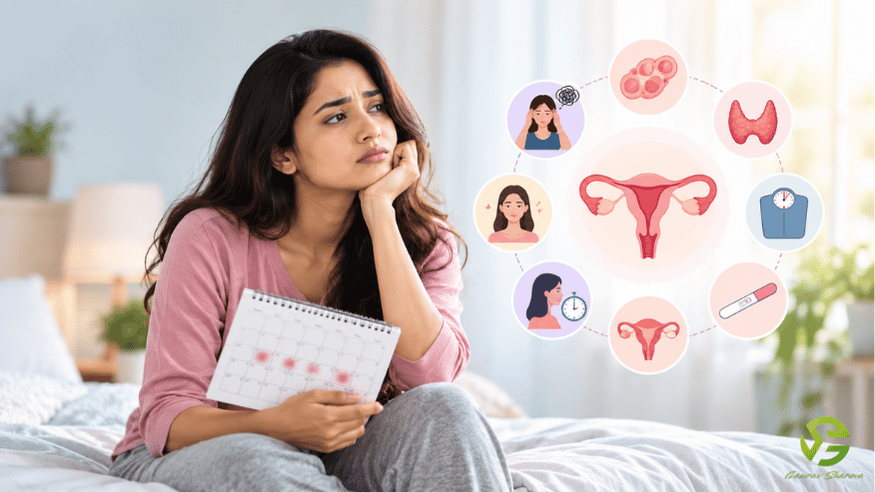
Irregular periods are a common concern among women of different age groups. Sometimes, a period may arrive a few days earlier or later than expected without indicating a serious problem. However, when your menstrual cycle becomes consistently unpredictable, periods are frequently missed, bleeding becomes unusually heavy, or you notice other symptoms, it is important to understand the possible cause.
Your menstrual cycle is influenced by hormones, overall health, stress, nutrition, body weight and reproductive health. Conditions such as PCOS, thyroid problems, hormonal imbalance, fibroids and perimenopause can also affect the regularity of periods.
Understanding why your periods are irregular can help you decide when medical evaluation is needed.
What Are Irregular Periods?
The menstrual cycle is counted from the first day of one period to the first day of the next. The cycle does not have to be exactly the same number of days every month.
However, periods may be considered irregular when there is a repeated change in your normal pattern, such as:
- Periods coming much earlier or later than usual
- Frequently missing periods
- Very different cycle lengths from month to month
- Bleeding that lasts unusually long
- Very heavy menstrual bleeding
- Spotting between periods
- Significant changes in your usual menstrual pattern
One unusual cycle does not necessarily mean there is a medical problem. If the changes continue for several months, however, it is worth discussing them with a gynecologist.
Common Causes of Irregular Periods
There are several possible reasons for irregular periods. Some are temporary, while others may need medical treatment.
1. Stress
Stress can affect the hormones responsible for ovulation. Significant emotional stress, work pressure, poor sleep, major lifestyle changes or physical stress can sometimes delay ovulation and cause a period to arrive later than expected.
If your menstrual cycle becomes irregular during a particularly stressful period and returns to normal afterward, the cause may be temporary.
However, persistent irregular periods should not automatically be blamed on stress.
2. PCOS
Polycystic ovary syndrome (PCOS) is one of the common causes of irregular periods.
Women with PCOS may not ovulate regularly, which can result in periods occurring less frequently or becoming unpredictable. Other symptoms may include acne, unwanted facial or body hair, weight changes and difficulty becoming pregnant.
PCOS is not only a menstrual problem. It can also involve hormonal and metabolic changes, so proper evaluation can be important.
For women experiencing PCOS or menstrual concerns, the Department of Obstetrics & Gynaecology in Ajmer provides women’s health and gynecological care.
3. Thyroid Problems
The thyroid gland plays an important role in many body functions, including reproductive health.
Both an underactive thyroid and an overactive thyroid can affect menstrual cycles. Some women may experience irregular periods along with fatigue, weight changes, changes in energy levels or other symptoms.
If your menstrual changes are accompanied by symptoms that could indicate a thyroid problem, your doctor may recommend thyroid testing and other investigations.
4. Changes in Body Weight
Significant weight gain or weight loss can affect hormone levels and ovulation.
Very low body weight, restrictive diets, excessive exercise or rapid weight loss may cause periods to become infrequent or stop. On the other hand, being overweight or obese can also be associated with hormonal changes and irregular cycles.
Maintaining a balanced diet, regular physical activity and a healthy weight can support overall reproductive health.
5. Perimenopause
As women approach menopause, hormone levels naturally begin to change. This stage is known as perimenopause and can begin several years before menopause.
During perimenopause, periods may become:
- Less predictable
- Heavier or lighter
- Shorter or longer
- More frequent or less frequent
Some women may also experience hot flashes, sleep difficulties, mood changes or vaginal dryness.
Although menstrual changes can be a normal part of perimenopause, very heavy bleeding or sudden changes should still be evaluated by a gynecologist.
6. Pregnancy
A missed period can be an early sign of pregnancy.
If you are sexually active and your period is late, pregnancy should be considered even if you do not have other noticeable symptoms.
A home pregnancy test can help determine whether pregnancy may be the reason for a missed period. Testing too early, however, can sometimes produce a negative result even when pregnancy is present.
If you want to understand the best timing for testing, read our guide on When Should You Take a Pregnancy Test for the Most Accurate Results?.
7. Uterine Fibroids
Fibroids are non-cancerous growths that can develop in or around the uterus. Their size and location can affect the symptoms they cause.
Some women with fibroids may experience:
- Heavy periods
- Longer periods
- Pelvic pain or pressure
- Abdominal fullness
- Frequent urination
- Problems with fertility in some cases
Not every fibroid requires treatment. Your gynecologist can determine whether monitoring or treatment is appropriate based on your symptoms and individual situation.
8. Hormonal Imbalance
A healthy menstrual cycle depends on the interaction of several hormones. Changes in hormone levels can affect ovulation and the timing of your periods.
Hormonal changes can be associated with PCOS, thyroid conditions, significant weight changes, perimenopause and other health conditions.
If irregular periods continue, your doctor may recommend blood tests or other investigations to understand what is causing the change.
Can Irregular Periods Affect Fertility?
Irregular periods do not necessarily mean that you cannot become pregnant.
However, if irregular periods are caused by irregular or absent ovulation, it can become more difficult to predict the fertile period and conception may take longer.
PCOS, thyroid problems and other hormonal conditions can affect ovulation.
If you are trying to conceive and your periods are consistently irregular, speaking with a gynecologist can help identify whether there is an underlying issue affecting ovulation or fertility.
When Should You See a Gynecologist?
You should consider seeing a gynecologist if your periods have become consistently irregular or significantly different from your normal pattern.
Medical evaluation is particularly important if you experience:
- Repeatedly missed periods
- Very heavy menstrual bleeding
- Periods that last unusually long
- Bleeding between periods
- Bleeding after sexual intercourse
- Severe menstrual pain
- Persistent pelvic pain
- Irregular periods along with acne or excessive facial hair
- Significant unexplained weight changes
- Difficulty becoming pregnant
- New menstrual changes around menopause
- A positive pregnancy test with pain or bleeding
You should not assume that persistent abnormal bleeding is simply a menstrual variation. A doctor can determine whether further evaluation is needed.
What Happens During a Gynecologist Consultation?
A gynecologist will usually begin by asking about your menstrual history and other symptoms.
You may be asked:
- When was your last period?
- How long is your usual menstrual cycle?
- How many days does bleeding normally last?
- Has your bleeding become heavier?
- Have you missed any periods?
- Do you experience pain?
- Are you sexually active?
- Are you trying to become pregnant?
- Have you experienced recent weight changes?
- Are you taking any medications?
- Do you have symptoms such as acne, excess hair growth, fatigue or hot flashes?
Depending on your symptoms, your doctor may recommend a pregnancy test, blood tests, thyroid or hormone testing, pelvic ultrasound or other investigations.
Not every woman with irregular periods needs every test. The appropriate evaluation depends on your age, symptoms, menstrual history and overall health.
Keep Track of Your Menstrual Cycle
Keeping a record of your periods can help you and your doctor understand whether there is a consistent pattern.
You can record:
- The first day of each period
- Number of days of bleeding
- Approximate amount of bleeding
- Pain or cramps
- Spotting between periods
- Other symptoms
- Pregnancy test results when relevant
You can use a mobile period-tracking app or simply mark the dates on a calendar.
Rather than worrying about whether your period arrives on one particular date, pay attention to changes in your overall pattern over several months.
How Are Irregular Periods Treated?
Treatment depends on the underlying cause.
For example, if PCOS or a thyroid condition is contributing to irregular periods, treatment may focus on managing that condition. If weight changes, stress or another lifestyle factor is involved, your doctor may recommend appropriate lifestyle adjustments.
Some women may need medication to regulate their menstrual cycle. Others may only require monitoring.
If fibroids, ovarian problems or another gynecological condition is identified, treatment will depend on the condition, its severity, symptoms and the woman’s reproductive plans.
It is important not to take hormonal medicines without medical advice simply to make your period arrive on a particular date.
Irregular Periods Do Not Always Mean Something Serious
An occasional late or early period can happen to many women. Stress, travel, illness, changes in sleep, weight fluctuations and other temporary factors can affect the menstrual cycle.
The important thing is to notice when the change becomes a repeated pattern.
If your periods have been irregular for several months, are becoming increasingly unpredictable, or are accompanied by heavy bleeding, significant pain, abnormal discharge, pelvic pain or fertility concerns, consulting a gynecologist can help identify the reason.
Gynecology Care at Kshetrapal Hospital, Ajmer
The Department of Obstetrics & Gynaecology at Kshetrapal Hospital, Ajmer provides care for women’s health concerns including menstrual problems, PCOS, infertility, pregnancy-related conditions and other gynecological conditions.
Women looking for a gynecologist in Ajmer can consult the department for evaluation of persistent menstrual changes and other reproductive health concerns.
For women with irregular periods related to hormonal or metabolic concerns, consultation with the Department of Endocrinology may also be recommended when appropriate.
Frequently Asked Questions
How many days late is considered an irregular period?
An occasional period that is a few days early or late does not necessarily indicate a problem. Repeated changes in cycle length or frequently missed periods are more important and may require medical evaluation.
Can stress cause irregular periods?
Yes. Significant physical or emotional stress can affect ovulation and may cause periods to become delayed or irregular.
Can PCOS cause irregular periods?
Yes. Irregular or infrequent periods are common with PCOS because ovulation may not occur regularly.
Can thyroid problems affect periods?
Yes. Both underactive and overactive thyroid conditions can affect menstrual cycles.
Can I get pregnant if my periods are irregular?
Yes. Irregular periods do not necessarily prevent pregnancy. However, irregular ovulation can make conception more difficult or make it harder to identify the fertile window.
When should I see a gynecologist for irregular periods?
You should consider consulting a gynecologist if irregularity continues, periods repeatedly disappear, bleeding becomes unusually heavy, you experience severe pain or abnormal bleeding, or you are having difficulty becoming pregnant.